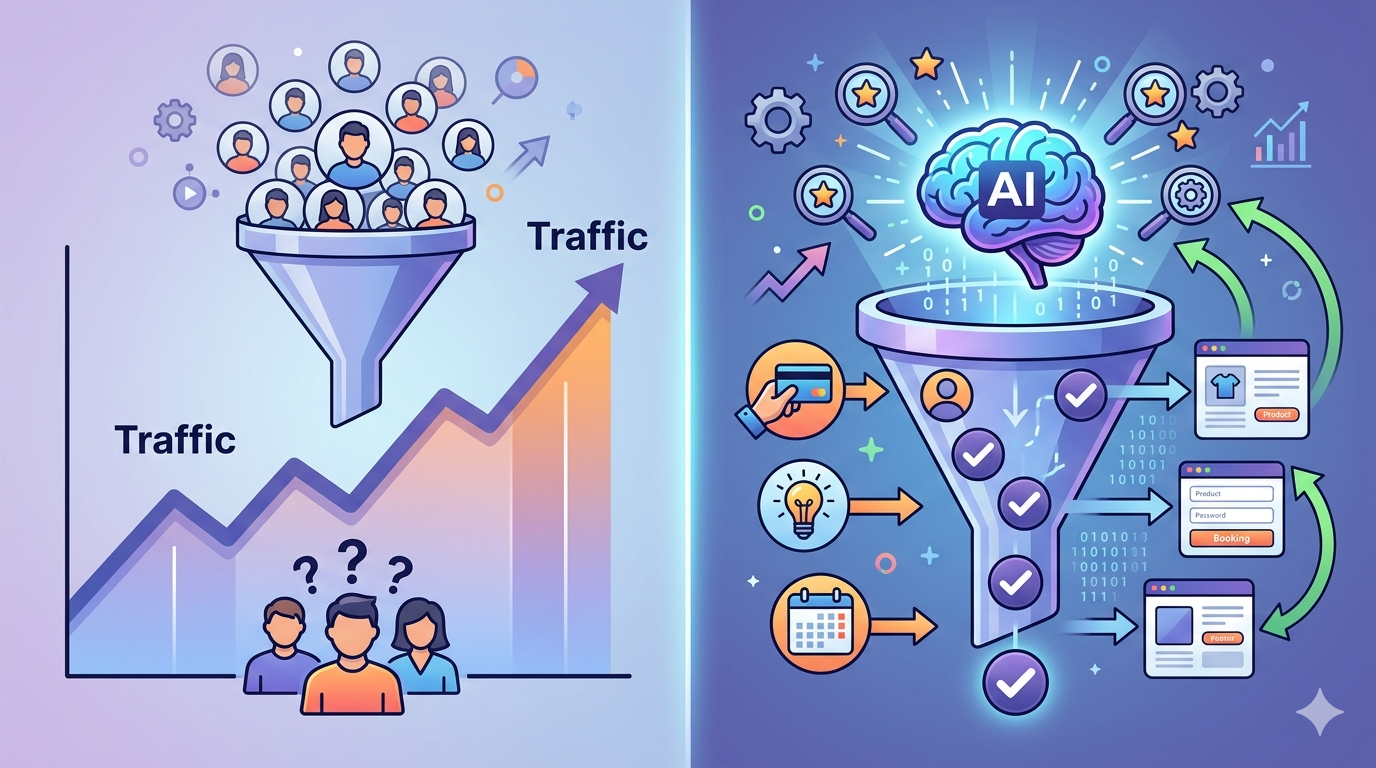
When Divya launched her B2B SaaS company’s new website last year, her growth strategy looked like every other playbook on the shelf: more content, more backlinks, more paid spend. Within four months, organic traffic climbed from 800 to 4,200 monthly visitors. Her SEO agency sent congratulatory reports full of graphs pointing upward.
Then she looked at her actual revenue.
Twelve new trials. A conversion rate of 0.28%. Her sales team was fielding discovery calls from people who couldn’t afford the product, didn’t understand what it did, or were at the very beginning of a research journey that wouldn’t end for another six months. Traffic had become a just a metric with impressive numbers and disappointing business results.
What Divya didn’t realize is that the nature of the people arriving at her website had fundamentally changed, not because of anything she’d done, but because of what AI had done to search itself.
This transformation is happening to marketing teams everywhere, and most CRO strategies haven’t caught up. The old model: drive more traffic, then optimize the funnel is being replaced by something far more nuanced: a world where the visitors who actually reach your site arrive pre-educated, pre-filtered, and pre-persuaded in ways that require a completely different conversion approach.
The Invisible Filter That’s Reshaping Your Traffic
To understand why modern CRO demands a new framework, you need to understand what’s happening upstream of your website, at the search bar itself.
Google’s AI Overviews now appear in approximately 13% of all U.S. desktop searches, a figure that doubled in just two months between January and March 2025.
Perplexity, ChatGPT, and Microsoft Copilot collectively generated 1.13 billion referral visits in June 2025 alone, a 357% increase from the same period the previous year.
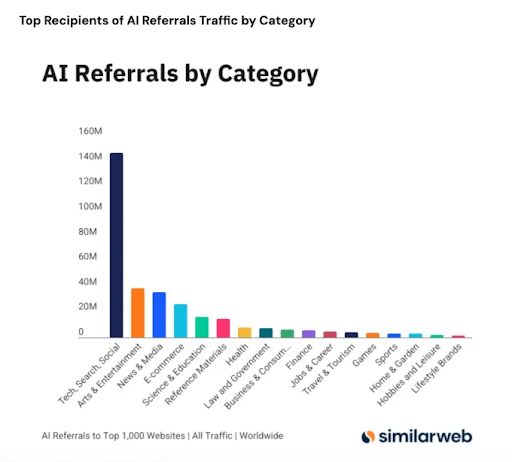
At the same time, research from Bain & Company(https://www.bain.com/) found that roughly 80% of consumers now rely on zero-click results for at least 40% of their searches, contributing to an estimated 15-25% decline in organic web traffic across independent sites.
The math is stark: for every 1,000 Google searches in the United States today, only around 360 clicks reach the open web.
But here’s what most CRO practitioners are missing entirely. This isn’t a traffic problem. It’s a traffic quality transformation, and it creates one of the most interesting conversion opportunities in the history of digital marketing.
The visitors who still click through to your website after encountering an AI Overview or an AI chatbot response are not the same people who were clicking through two years ago. By the time they arrive on your landing page, they are further along the buyer journey than any cold organic visitor has ever been at the point of first click.
Industry data confirms the magnitude of this shift. A study analyzing 12.3 million website visits across 347 businesses found that AI search traffic converts at 14.2% compared to Google organic traffic’s 2.8%.
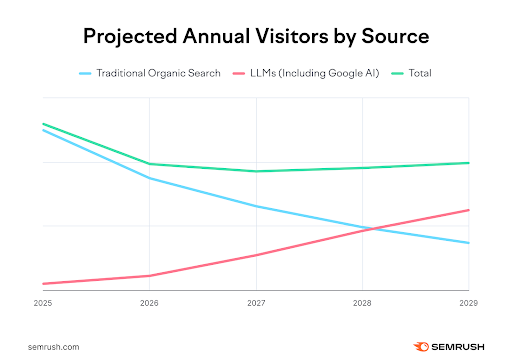
Traffic referred from Claude converts at 16.8%. ChatGPT users view an average of 2.3 pages per session compared to just 1.2 for Google organic visitors. When you combine the behavioral signals, deeper browsing, longer sessions, higher purchase intent, a pattern emerges that should reshape every conversion rate optimization strategy being built today.
The visitors coming from AI platforms aren’t browsing. They have already decided.
Why Traditional CRO Fails These Visitors
The challenge is that most landing pages and conversion funnels were built for a different kind of visitor, one who arrives skeptical, uninformed, and needs to be educated from scratch before being asked to act.
Traditional CRO ideas prescribes building trust from zero: establish credibility, introduce the problem, present the solution, handle objections, provide social proof, then call to action. This funnel assumes a visitor with low intent and high uncertainty. It’s designed for the casual browser who stumbled upon your site through a broad informational search.
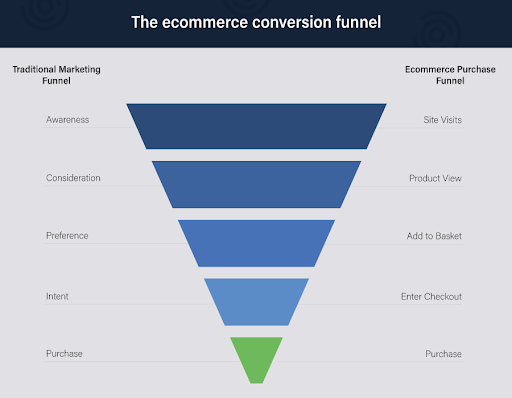
That visitor is increasingly rare. And even when they do arrive, they’re often the wrong lead anyway.
The high-intent visitor coming from an AI platform doesn’t need you to convince them the problem exists. They’ve already spent twenty minutes discussing the problem with ChatGPT.
They don’t need a lengthy explanation of how your category of solution works, Perplexity already gave them a comparative overview of five alternatives. What they need, with urgent specificity, is confirmation that your particular solution is the right match for their specific situation.
This distinction sounds subtle but it produces dramatic differences in conversion behavior. A visitor who arrives already understanding what you do will bounce instantly from a landing page that opens with foundational explanations they don’t need.
They’ll look for specifics, use cases that match their context, pricing that confirms viability, proof that works for someone like them
Research on zero-click search behavior reinforces this.
The Semrush analysis of 10 million keywords found that AI Overviews are increasingly targeting commercial and transactional intent searches, not just informational ones.
Since October 2024, the percentage of commercial, transactional, and navigational keywords triggering AI Overviews has grown measurably. This means the pre-education effect is now reaching buyers who are closer to a purchase decision, and their intent when they click through is correspondingly more specific and urgent.
Rethinking the Conversion Funnel for an AI-Search World
The traditional top-of-funnel, middle-of-funnel, bottom-of-funnel model assumed that traffic arrived at the top and needed to be guided through sequential stages. AI search has collapsed this model. A significant portion of your visitors are arriving pre-qualified at the middle or bottom of the funnel, they’ve done the top-of-funnel work in conversation with an AI.
This creates three distinct visitor types that modern CRO must account for:
The AI-educated evaluator has already researched the problem and category using ChatGPT, Perplexity, or similar tools. They arrive knowing roughly what they need and are now in comparison mode.
The AI-citation seeker encountered your brand name or content within an AI-generated answer and clicked through to verify or deepen the information. They arrived with a specific informational need.
The traditional browser still arrives through conventional organic search on informational queries that AI hasn’t fully captured. These visitors need the traditional educational funnel. But their share of your traffic is likely shrinking, and building your entire CRO strategy around them means optimizing for a declining audience.
The critical insight is that these visitor types require different conversion experiences, and conflating them with a single generic landing page produces poor results for all three.
The Gap Where Conversion Is Actually Lost
Most CRO audits focus on the obvious: button color, headline copy, form length, page speed. These optimizations matter, but they address symptoms rather than the underlying cause of conversion failure in the AI search era.
The deeper problem is an intent-match gap, the disconnect between the intent a visitor carries when they arrive and the experience your page delivers in the first few seconds.
Consider how this gap forms.
A user asks Perplexity to compare project management tools for software development teams and receives a comprehensive overview that mentions your product as particularly suited to agile workflows.
Intrigued, they click through to your site. They land on a generic homepage that talks about “streamlining team collaboration” with stock photography of smiling people in open offices.
Nothing confirms their specific context. Nothing speaks to software teams or agile specifically. Within eight seconds, they conclude this isn’t quite what they were looking for and return to the AI platform to continue comparing alternatives.
You had a highly qualified, purchase-ready visitor. You lost them not because of a weak CTA or slow page load, but because your page communicated something different from what the AI had told them to expect.
The data from Bing’s internal research on AI search behavior captures this precisely: visitors from AI search environments convert at rates matching or exceeding traditional search specifically because of stronger intent alignment at the moment of arrival. The conversion happens when the landing page confirms, in the first moments of engagement, that it delivers what the AI suggested it would.
This means modern CRO must work upstream. Optimizing the landing page in isolation isn’t enough. You need to understand how AI platforms are describing you and to whom, and then ensure your conversion experience matches those descriptions.
A Framework for Intent-Matched CRO
Building a CRO program that captures the AI search opportunity requires a different approach than traditional optimization. Here’s how to structure it:
Step 1: Audit your AI presence before your landing pages
Before analyzing your conversion funnel, understand what AI platforms are telling people about you. Use ChatGPT, Perplexity, Claude, and Google’s AI Mode to ask the questions your target customers would ask. How is your product described? What use cases are attributed to you? What objections or limitations do the AI responses mention?
Document what AI platforms say about you across twenty to thirty relevant queries. This becomes the foundation for your CRO messaging strategy.
Step 2: Segment traffic by source intent, not just by source
Most analytics setups group “organic search” and “AI referral” as separate traffic sources. But the more important segmentation is by intent stage. Visitors arriving from Perplexity comparison queries have different intent than visitors arriving from ChatGPT conceptual questions, even though both are technically AI referral traffic.
Use referral data, landing page patterns, and on-site behavior to infer intent stage. Visitors who land on comparison pages and immediately navigate to pricing are exhibiting late-stage buying behavior. Visitors who land on a blog post and consume three or four pieces of content before reaching a product page are moving through earlier stages. Optimize conversion touchpoints for the intent stage that traffic exhibits, not just for the channel that drove it.
Step 3: Design landing pages as intent confirmers, not intent creators
The most powerful conversion shift for AI-era traffic is reframing what a landing page does. Traditional landing pages try to create intent, they establish the problem, build desire, and work to generate motivation to act. Intent-matched landing pages confirm existing intent, they validate that the visitor has arrived in the right place and lower the friction to the next step.
This distinction shows up in specific design choices. An intent-confirming landing page opens with a headline that speaks directly to the context the visitor likely carries: “Built for Software Development Teams Running Agile Sprints” rather than “Team Collaboration Made Simple.”
Step 4: Align social proof with AI-shaped expectations
When an AI platform recommends your solution in a specific context, visitors arrive with implicit expectations about who else uses you and for what. Your social proof must confirm those expectations to close the conversion.
A visitor who arrived because Perplexity described you as popular with fintech startups will find a case study from a Fortune 500 manufacturing company unconvincing, not because it isn’t impressive, but because it doesn’t match the profile they arrived expecting. Worse, it may create doubt about whether you actually serve companies like theirs.
Step 5: Optimize for the second click, not just the first
One of the most overlooked insights from AI search behavior is what happens at the research-visit interface. Visitors coming from AI platforms don’t just arrive at your site, they often arrive comparing your site against alternatives they’ve been researching in the same AI conversation. This means they may visit your page, visit a competitor’s page, and return to the AI to continue the conversation before making a decision.
The brands cited in AI Overviews earn 35% more organic clicks and 91% more paid clicks compared to those not cited, according to research on position zero optimization. But the long-term conversion opportunity is equally about what happens when visitors return to the AI after visiting your page.
This creates a feedback loop that traditional CRO never considered. Every interaction a visitor has with your site that demonstrates clear value, specific expertise, or strong problem-solution alignment contributes to the AI’s model of your brand authority.
The Wasted Emission Problem, Applied to CRO
There’s an angle to this shift that most marketers haven’t considered, drawing on research that connects website performance to environmental impact.
The Acara Strategy case study conducted by Everything Green found that 74% of a website’s carbon emissions come from visitor devices, not servers, not data centers, but the energy consumed by people browsing. Every visitor who arrives on your site, fails to find what they need, and bounces represents pure energy waste: your infrastructure ran, data moved across networks, their device rendered your page, and none of it produced value.
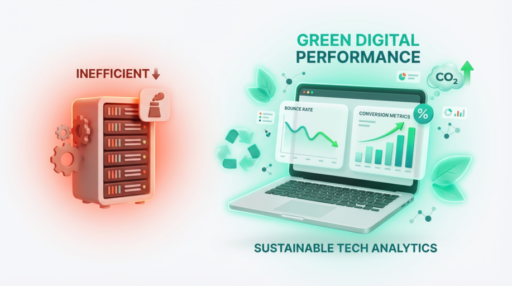
In a world where AI search delivers pre-qualified visitors with high intent, a low conversion rate isn’t just a revenue problem. It’s an efficiency problem with a measurable environmental cost. Websites with poor conversion rates essentially burn energy for nothing, while high-converting sites ensure every watt of energy spent delivers actual value.
The Metrics That Matter Now
Traditional CRO success metrics were built around a high-volume, low-intent traffic model: bounce rate, pages per session, time on site, funnel step completion. These metrics remain useful but insufficient for the AI search era.
The visitor landscape now demands an expanded measurement framework:
Conversion rate by traffic source intent stage. Aggregate conversion rate tells you little when your traffic is a mixture of pre-qualified AI-referred visitors and early-stage information browsers. Segmenting conversion rate by inferred intent stage reveals where you’re actually succeeding and failing.
AI citation coverage. The MarTech framework identifies “answer inclusion rate”, how often your brand’s content appears inside AI-generated answers, as a leading indicator of future conversion performance. Brands appearing in AI Overviews earn disproportionate share of the clicks that do happen, and those clicks convert better.
Intent-match quality. A proxy metric you can build by analyzing on-site behavior after AI referral traffic arrives: do visitors immediately navigate to the pages that match the context they were referred for, or do they browse generically? High intent-match quality looks like direct navigation to specific use-case or comparison pages. Low intent-match quality looks like aimless browsing followed by exit.
Time-to-conversion for AI-referred visitors. If AI referral traffic carries stronger purchase intent, you should observe shorter paths to conversion compared to organic search traffic. If you don’t, it’s a signal that your conversion experience isn’t meeting those visitors where they are.
What This Means for Small Teams
The counterintuitive good news in all of this is that intent-matched CRO doesn’t require larger budgets or more complex tooling than traditional CRO. In many ways, it requires less.
You don’t need to test dozens of minor variations to optimize for AI-era visitors. You need to deeply understand the intent context they carry when they arrive, and then align your messaging, social proof, and conversion paths to that context. This is primarily a thinking problem, not a tools problem.
The businesses that thrived through the 2025 organic traffic disruption shared two characteristics, according to a survey of 3,000 companies: an omnichannel approach to customer experience, and a strong focus on conversion rate optimization that captured value from existing traffic regardless of volume. Neither advantage required enterprise budgets. Both required clear thinking about what arriving visitors actually need.
Conclusion
The marketers who will win in the next three years aren’t those who drive the most traffic. They’re those who build conversion experiences precisely matched to the intent of visitors shaped by AI search.
This means auditing what AI platforms say about you before optimizing your landing pages.
- It means segmenting conversion performance by intent stage rather than just traffic source.
- It means designing pages that confirm existing intent rather than create it from scratch.
- It means measuring success not just by aggregate conversion rate but by how well your experience serves the different intent contexts that modern visitors arrive with.
Traffic is becoming more qualified and more scarce simultaneously. The only rational response is to make sure every visit counts, by building conversion experiences that match the intent your visitors bring with them, wherever AI sent them from.
References
TechCrunch. (2025, July 25). AI referrals to top websites were up 357% year-over-year in June, reaching 1.13B.
Semrush. (2025). We studied the impact of AI search on SEO traffic. (Referenced for 12.3 million visits study, 14.2% AI conversion vs. 2.8% organic, Claude 16.8%, ChatGPT 2.3 pages/session; aligns with ~5x multiplier in analyses).
Bain & Company. (n.d.). Zero-click search reliance study. (For 80% consumers using zero-click for 40% searches; exact report inferred from secondary coverage).
Everything Green. (2025, December 17). Is your bounce rate killing the planet? The Acara case study. (For 74% emissions from visitor devices).
Optiminder. (n.d.). Conversion funnel optimisation.
Search Engine Land. (2025, May 5). Google AI Overviews now show on 13% of searches: Study. (13% US desktop in March 2025, doubled from January).
PPC Land. (2025, November 4). Google AI Overviews reduce organic CTR 61%, paid traffic 68%. (Brands in AIOs get 35% more organic clicks, 91% more paid).
Agarwal, P. K., et al. (2024). GEO: Generative engine optimization. arXiv. (Foundational GEO paper; article alludes to AI citation dynamics).
Strubell, E., Ganesh, A., & McCallum, A. (2019). Energy and policy considerations for deep learning in NLP. Proceedings of the 57th Annual Meeting of the Association for Computational Linguistics, 3645–3650.