When Rachel, a digital marketing manager at a mid-sized e-commerce company, discovered ChatGPT last year, she thought she’d found the perfect solution to her content bottleneck. Within weeks, her team was using AI to generate product descriptions, email campaigns, social media posts, and blog outlines. Productivity soared. Her boss was thrilled.
Then Rachel attended a sustainability workshop and learned something that stopped her in her tracks: a single ChatGPT query can use as much electricity as charging a smartphone. Her team was running hundreds of AI queries daily. She calculated they were potentially generating more carbon emissions from AI tools than from their entire office’s annual electricity consumption.
This realization sparked an uncomfortable question: was her marketing efficiency coming at an unacceptable environmental cost?
Rachel’s story reflects a growing tension in modern marketing. AI and large language models (LLMs) have become indispensable tools, promising unprecedented efficiency and creativity. Yet beneath the surface of every prompt, every generated image, and every automated workflow lies a hidden carbon footprint that most marketers never consider.
The uncomfortable truth is this: AI marketing isn’t just changing how we work, it’s changing how much energy the digital economy consumes. As marketers increasingly rely on AI tools to stay competitive, understanding and minimizing their environmental impact has shifted from a nice-to-have concern to a business imperative.
This guide will show you exactly how to measure the carbon cost of your AI usage, implement smarter practices that reduce environmental impact without sacrificing results, and position your brand as a leader in sustainable digital marketing.
The Hidden Energy Cost Behind Every AI Prompt
Before you can reduce AI’s carbon footprint, you need to understand what creates it in the first place.
Every time you use an AI tool, something remarkable happens behind the scenes. Your prompt travels to massive data centers housing thousands of specialized processors called GPUs (Graphics Processing Units). These GPUs work in parallel, processing your request through neural networks containing billions of parameters. The model searches through its training data, calculates probabilities for each possible next word or pixel, and generates a response.
This computational process consumes substantial electricity. But the energy cost doesn’t stop at inference (the actual generation of responses). The full lifecycle includes three distinct phases, each contributing to the overall carbon footprint.
Training represents the most energy-intensive phase. Creating a large language model requires processing enormous datasets through specialized hardware for weeks or months. GPT-3’s training phase reportedly consumed 1,287 MWh of electricity, equivalent to the annual power consumption of 120 U.S. homes. GPT-4’s training likely required significantly more, though exact figures remain undisclosed.
Inference happens each time someone uses the model. While individual queries consume less energy than training, the cumulative impact becomes substantial when billions of people use these tools daily. A study from researchers at the University of Washington and Allen Institute for AI found that generating 1,000 text outputs with a 13-billion parameter model consumed as much energy as charging a smartphone.
Infrastructure maintenance includes the constant cooling systems required to prevent data centers from overheating, the backup power systems ensuring uninterrupted service, and the network infrastructure transmitting data between users and servers.
The carbon intensity of this energy consumption varies dramatically depending on where the data center operates. A model running in Iceland (powered largely by geothermal and hydroelectric energy) generates far less carbon than the same model running in a coal-dependent region.
This geographic variation creates a hidden variable in AI’s environmental impact that most marketers never consider: two identical AI tasks can have radically different carbon footprints depending on which data center processes them.

How Your Marketing AI Stack Compares: Carbon Footprint by Tool
Not all AI tools carry the same environmental weight. Understanding these differences helps you make informed choices about which tools to use and when to use them.
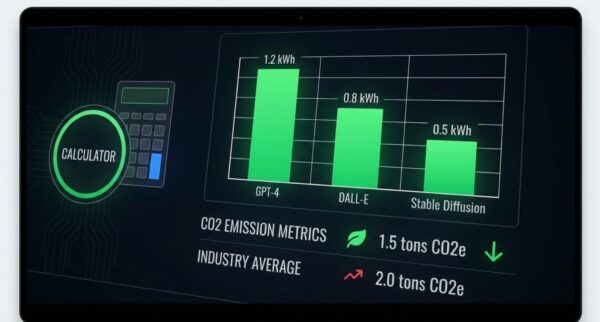
Text generation models vary significantly in their energy consumption based on model size and architecture. ChatGPT (GPT-4) represents the higher end, using approximately 0.001-0.002 kWh per query. Smaller models like GPT-3.5 consume roughly 40% less energy per query while still handling many marketing tasks effectively. Open-source alternatives like LLaMA 2 can be run on more efficient hardware, potentially reducing per-query energy consumption by 60% or more compared to GPT-4.
Image generation tools require substantial computational power. DALL-E 3 and Midjourney consume approximately 0.003-0.005 kWh per image generated. Stable Diffusion, designed for efficiency, uses about 0.002 kWh per image. Each image generation also requires multiple iterations (most marketers generate 10-20 variants before selecting a final image), multiplying the energy cost significantly.
Video creation AI tools represent the highest consumption category. New tools can consume 0.05-0.1 kWh per minute of generated video, as video generation requires processing thousands of frames and maintaining temporal consistency across scenes.
AI-powered analytics and automation platforms run continuously, creating ongoing energy consumption. The tools that optimize campaigns in real-time consume energy proportional to their processing frequency and data volume.
To put these numbers in perspective, consider a typical marketing team’s daily AI usage:
- 50 ChatGPT-4 queries for content outlines and research: ~0.075 kWh
- 20 image generations with multiple iterations (200 total): ~0.6 kWh
- 5 short videos (30 seconds each): ~0.125 kWh
- Continuous campaign optimization platform: ~0.2 kWh
This single day’s AI usage totals approximately 1 kWh, equivalent to running a standard laptop for an entire workday. Scale this across 250 working days and dozens of team members, and the annual energy consumption becomes substantial.
Measuring Your Marketing AI Carbon Footprint: A Practical Framework
You can’t manage what you don’t measure. Fortunately, calculating your AI carbon footprint is more straightforward than most marketers expect.
The basic calculation follows a simple formula:
Carbon Emissions = (Energy Consumed per Query × Number of Queries × Grid Carbon Intensity)
Breaking this down into actionable steps:
Step 1: Audit Your AI Tool Usage
Start by cataloging every AI tool your marketing team uses. Create a spreadsheet tracking the tool name, primary use case (content generation, image creation, analytics), average daily queries or generations, and model type or size when known.
Most teams underestimate their AI usage by 40-60% when asked to estimate without tracking. Install time-tracking extensions or review usage dashboards provided by AI platforms to get accurate data. Track for at least two full weeks to capture typical usage patterns.
Step 2: Estimate Energy Consumption
Use the benchmark figures provided earlier as starting points. When specific consumption data isn’t available, follow these estimation rules:
For text models, assign 0.002 kWh per query for large models (GPT-4, Claude), 0.001 kWh for medium models (GPT-3.5, PaLM 2), and 0.0005 kWh for small models.
For image generation, use 0.004 kWh per image for high-resolution tools and 0.002 kWh for efficient models. Remember to multiply by the average number of iterations per final image (typically 10-15).
For video and more complex tasks, consult provider documentation or use third-party carbon calculators like ML CO2 Impact or Green Algorithms.
Step 3: Determine Grid Carbon Intensity
The carbon intensity of electricity varies by location and changes throughout the day based on energy sources active at that time. In 2024, the global average is approximately 475 grams of CO2 per kWh, but regional variations are dramatic.
European Union averages around 250 g CO2/kWh due to significant renewable adoption. The United States averages 400 g CO2/kWh, with states like California at 200 g CO2/kWh while coal-dependent states exceed 700 g CO2/kWh. China averages 600 g CO2/kWh, and India exceeds 700 g CO2/kWh.
Most cloud providers won’t disclose exactly which data center processes your request, so use regional averages for where the provider’s primary data centers operate. Google Cloud provides the most transparent carbon data, allowing you to choose specific regions with lower carbon intensity.
Step 4: Calculate Total Emissions
Multiply your total daily energy consumption (from Step 2) by your grid carbon intensity (from Step 3). This gives you grams of CO2 per day. Scale this to monthly or annual figures to understand the full scope.
A marketing team using 5 kWh daily of AI services in an average U.S. location generates approximately 730 kg of CO2 annually—equivalent to driving a car 1,800 miles or the carbon absorbed by 33 tree seedlings grown for 10 years.
Six Strategies to Reduce AI Carbon Footprint Without Sacrificing Results
Understanding your carbon footprint means nothing without action. These six strategies help marketing teams reduce AI-related emissions by 40-70% while maintaining or improving campaign performance.
1. Choose the Right Model for the Task
The single most impactful change most teams can make is using smaller, more efficient models for tasks that don’t require maximum capability.
GPT-4 excels at complex reasoning, nuanced brand voice matching, and sophisticated content strategy. But for routine tasks (generating social media captions, creating first drafts of product descriptions, basic email personalization), GPT-3.5 or Claude Haiku deliver comparable results with 40-60% less energy consumption.
Similarly, for image generation, test whether Stable Diffusion produces acceptable results before defaulting to DALL-E 3 or Midjourney. Many marketing visuals don’t require the absolute highest quality models provide.
Create clear guidelines for your team specifying which model to use for different tasks. “Use GPT-4 for brand storytelling and strategic content; use GPT-3.5 for social posts and routine descriptions” provides clarity while reducing energy waste.
2. Optimize Your Prompts for Efficiency
Well-crafted prompts generate better results in fewer attempts, directly reducing energy consumption.
Vague prompts require multiple regenerations. “Write a blog post about sustainable marketing” might need 5-10 attempts before producing usable content. Each regeneration consumes energy.
Specific prompts deliver better results immediately. “Write a 1,500-word blog post for B2B sustainability consultants explaining how to measure Scope 3 emissions. Use a professional but approachable tone. Include three case study examples and end with actionable next steps” will likely produce a usable first draft.
This specificity reduces both energy consumption and your team’s time. Track your regeneration rate (how many attempts before getting usable output) as a key efficiency metric. Teams improving from 3 attempts per task to 1.5 attempts cut their AI carbon footprint by 50% while improving productivity.
3. Batch Similar Tasks
AI models can process multiple similar requests more efficiently than handling them one at a time. Instead of generating product descriptions individually throughout the day, batch 20-30 descriptions into a single session. This approach reduces the computational overhead of initializing the model repeatedly.
Similarly, batch your image generation needs. Creating 10 similar images in one session (with variations specified in the initial prompt) consumes less total energy than generating those 10 images across separate sessions.
4. Implement Local Processing When Possible
Not every AI task requires cloud-based models. Smaller, specialized models can run directly on your computer or local server, eliminating data transmission energy and reducing reliance on energy-intensive data centers.
Grammar checking and basic copyediting can use local tools like Grammarly’s desktop version or LanguageTool. Simple image editing and enhancement can leverage local software with AI features rather than cloud-based solutions. Basic data analysis and pattern recognition can often happen through local Python scripts using lightweight ML libraries.
The energy to run AI locally on your existing hardware is minimal since your computer is already powered. This approach works best for routine, repetitive tasks that don’t require the most advanced models.
5. Schedule AI-Intensive Work During Low-Carbon Hours
The carbon intensity of electricity grids varies throughout the day. In most regions, renewable energy contributes more heavily during daylight hours when solar generation peaks. Fossil fuel plants typically ramp up during evening demand peaks.
For non-urgent AI tasks (bulk content generation, asset creation, data processing), schedule work during low-carbon hours. In most U.S. regions, this means midday (11 AM – 3 PM) when solar generation peaks. In areas with significant wind power, overnight hours may be cleaner.
WattTime provides free API access showing real-time grid carbon intensity, allowing teams to automatically schedule AI workloads during cleaner hours.
6. Choose Providers with Strong Renewable Commitments
Where your AI provider sources electricity matters enormously. Providers powered by renewable energy deliver the same capabilities with dramatically lower carbon footprints.
Google Cloud has achieved carbon neutrality and runs several regions on 90%+ renewable energy. Their data centers in Montreal, Finland, and Iowa operate on particularly clean grids.
Microsoft Azure has committed to being carbon negative by 2030 and offers “carbon-aware” regions where workloads automatically route to lower-carbon data centers.
Anthropic (Claude) purchases renewable energy credits matching their consumption and provides transparency about their carbon footprint.
When selecting AI tools, explicitly ask providers about their renewable energy usage, carbon offset programs, and facility locations. Many enterprise contracts now include sustainability clauses requiring providers to disclose and minimize environmental impact.
The Business Case for Low-Carbon AI Marketing
Reducing your AI carbon footprint isn’t just an ethical choice, it’s increasingly a business advantage. Three trends are making low-carbon AI practices valuable to your bottom line.
- Consumer preference for sustainable brands is accelerating. A 2024 study found that 73% of millennials and Gen Z consumers consider sustainability when making purchase decisions. Brands that authentically demonstrate sustainability commitments (including in their marketing operations) gain competitive advantage.
- Regulatory pressure is mounting. The European Union’s Corporate Sustainability Reporting Directive (CSRD) requires companies to disclose their entire value chain emissions, including digital operations. California’s climate disclosure law extends similar requirements to large businesses operating in the state. As these regulations expand, companies unprepared to measure and report AI-related emissions face compliance costs and potential penalties.
- Efficiency improvements drive cost savings. The same practices that reduce carbon footprint also reduce AI service costs. Using smaller models, optimizing prompts, and batching tasks doesn’t just save energy; it reduces your monthly bills from AI providers.
Marketing leaders implementing sustainable AI practices report additional benefits including enhanced employee satisfaction (teams appreciate working for environmentally conscious employers), differentiated positioning in RFPs (many enterprise buyers now require sustainability credentials), improved brand reputation when sustainability practices are communicated transparently, and innovation catalyst effect (teams optimizing AI usage often discover better workflows and strategies).

How Everything Green Helps Marketing Teams Measure and Reduce Their Digital Carbon Footprint
Understanding your AI carbon footprint is just the first step. Continuous measurement and optimization require tools built specifically for this purpose.
Everything Green provides the comprehensive platform marketing teams need to measure, monitor, and minimize their digital carbon footprint across all channels, including AI and LLM usage.
Our platform tracks the carbon impact of your entire digital marketing stack, from website performance to campaign delivery to AI tool usage. We integrate directly with major AI providers, automatically calculating energy consumption and carbon emissions for your team’s usage patterns. Our dashboard shows real-time carbon metrics alongside traditional marketing KPIs, helping you understand the environmental impact of every campaign decision.
Beyond measurement, Everything Green provides actionable recommendations for reducing emissions without compromising results. Our AI optimization engine suggests when to use smaller models, identifies opportunities for batching similar tasks, and recommends scheduling adjustments to take advantage of low-carbon electricity hours.
For marketing agencies and enterprise teams, we offer white-label carbon reporting that you can share with clients, demonstrating your commitment to sustainability. This transparency builds trust and differentiates your services in a crowded market.
Start measuring your marketing carbon footprint today with Everything Green’s free trial. See exactly where your emissions come from and get personalized recommendations for reducing them.
FAQ
1. Is AI actually worse for the environment than traditional marketing methods?
Not necessarily. AI tools can be more efficient than traditional methods for certain tasks. A human researcher flying to conduct interviews or a photographer driving to multiple locations might generate more carbon emissions than equivalent AI-generated alternatives. The key is using AI strategically for tasks where it provides genuine efficiency gains rather than defaulting to AI for everything.
The environmental concern arises when teams use powerful AI models unnecessarily or generate excessive variations without strategic purpose.
2. How accurate are carbon footprint calculations for AI usage?
Current calculation methods provide reasonable estimates (accurate to within ±30% in most cases) but aren’t perfectly precise. Energy consumption varies based on model load, server efficiency, cooling requirements, and other factors that users can’t directly observe. However, estimated figures are sufficient for tracking trends, comparing options, and making informed decisions about AI usage patterns.
As providers become more transparent about energy metrics, calculation accuracy will improve.
3. Aren’t AI providers already working on efficiency improvements?
Yes, major AI companies are actively improving energy efficiency. Model architectures are becoming more efficient, data centers are adopting renewable energy, and cooling systems are being optimized. Google reported reducing their data center energy usage by 30% through AI-optimized cooling systems.
However, efficiency improvements are being outpaced by increased usage and larger models. Overall AI energy consumption is rising despite per-query improvements. Individual users still need to make conscious choices about when and how to use AI tools.
4. Should I avoid using AI tools altogether for environmental reasons?
No. AI tools provide genuine value and efficiency gains for many marketing tasks. The goal isn’t eliminating AI usage but using it strategically and minimizing unnecessary consumption. Focus on using the right tool for each job, optimizing your prompts, and choosing providers committed to sustainability.
Strategic AI usage often produces better environmental outcomes than alternative approaches.
5. How can I communicate my sustainable AI practices to customers?
Transparency builds trust, but avoid greenwashing by making specific, verifiable claims. Instead of generic statements like “we use sustainable AI,” share concrete details such as the percentage of your AI workload running on renewable-powered servers, your year-over-year reduction in AI-related emissions, or your commitment to using carbon-efficient models when appropriate.
Consider publishing an annual sustainability report that includes digital operations alongside traditional metrics. Many customers appreciate this transparency even if they don’t understand technical details.
6. What’s the future of sustainable AI for marketing?
Several trends point toward more sustainable AI practices becoming standard. Major providers are competing on sustainability metrics, making carbon-efficient options more accessible. New model architectures are dramatically improving efficiency (some emerging models deliver GPT-3 level performance with 90% less energy). Carbon-aware computing is automatically routing workloads to cleaner energy sources.
Regulatory requirements are forcing companies to measure and disclose AI-related emissions.
Within 3-5 years, sustainable AI practices will likely shift from competitive advantage to basic expectations.