Decoding Corporate Emissions: Exploring Scope 1, 2, and 3 and their Impact on Sustainability
As the world pushes for sustainability and urgent climate action, corporate emissions play an increasingly critical role. The intricacies surrounding emissions under Scope 1, Scope 2, and Scope 3 emissions categories have come to the forefront and are shaping the approach to sustainable practices. In order to achieve net zero and carbon neutrality, it is important to understand these emissions and how controlling them can benefit us all.
In this article, we will break down these terms into their simplest forms and offer an expansive exploration of their profound relevance and the far-reaching consequences they bear on the well-being of our planet.
Introduction to the Concept of Corporate Emissions and Their Significance in Sustainability Efforts
Organization/Corporation generate corporate emissions.. This includes emissions from the corporation’s factories, vehicles, and power plants, as well as those generated by third parties who supply the corporation’s energy. These emissions are categorized into, Scope 1, Scope 2 and Scope 3. Let’s take a look at them.
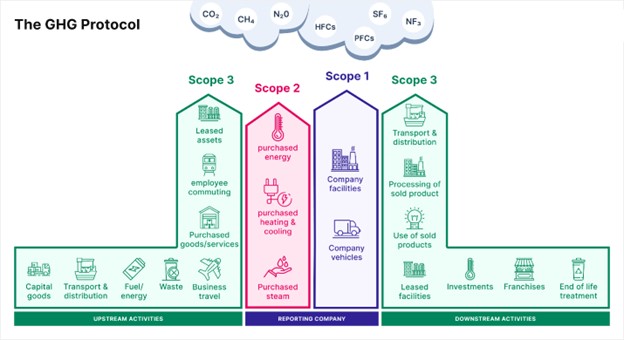 Source: Cicrularise
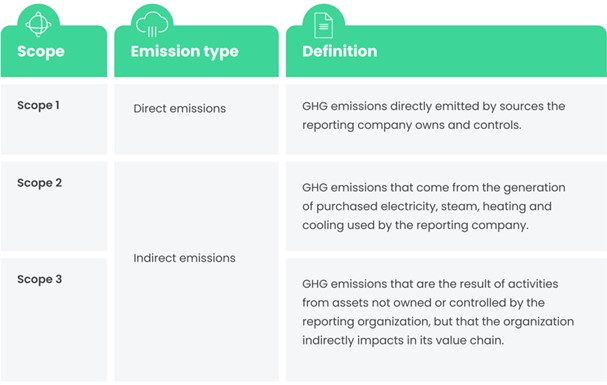
Scope 1: These are also known as Direct Emissions, and include all emissions produced by the companies’ owned operations, things like the company building, and company-owned vehicles. These emissions are the result of actions that the company directly controls. For example, when a manufacturing facility burns fossil fuels like coal or gas to power its machinery, it directly releases emissions on-site. Similarly, a company-owned delivery fleet produces direct emissions every time its vehicles operate.
Scope 3: These are equally referred to as Indirect Emissions, and they encompass the entire value chain of a corporation. That is all activities both in and outside the company that have a connection with the company. Beginning from the suppliers at the top to the customers at the bottom.
Source: Net0
How Organizations Can Mitigate Emissions in Each Scope
Mitigating Scope 1 Emissions
Innovative companies can take bold steps to slash their Scope 1 emissions by implementing comprehensive strategies. These strategies include switching from traditional vehicles to electronic vechiles (EVs), using renewable energy for operations, and adopting cleaner industrial processes. For example, a car manufacturer might use electric trucks for deliveries, while a factory could replace fossil fuels with solar power to reduce direct emissions.
Companies can make significant strides to mitigate their Scope 2 emissions by strategically addressing their energy consumption. One approach involves procuring renewable energy directly, such as installing solar panels on company buildings or purchasing renewable energy credits. By doing so, they are not only decreasing their reliance on fossil-fuel-generated electricity but also fostering a cleaner energy mix. Take a technology company as an example; they can partner with wind farms to ensure a portion of their electricity comes from renewable sources, effectively reducing their indirect emissions tied to energy consumption.
Mitigating Scope 3 Emissions
Again, companies can forge collaborative efforts with their supply chain partners to manage their Scope 3 emissions. These efforts include optimizing logistics and transportation to minimize emissions generated during the transportation of goods. Additionally, they can embrace circular economy principles, where materials are recycled and reused, reducing the overall environmental impact. Take for instance a fashion brand collaborating with suppliers to minimize transportation distances and employing recycled materials for their products, thereby reducing both transportation-related and product lifecycle emissions.
How Organizations Can Measure Scope 1, 2, and 3 Emissions
One of the most effective ways for organizations to measure their emissions is by leveraging cutting-edge technologies. Depending on your location and your industry, there are software dedicated to helping you accurately measure emissions. Most of these tools work simply: you upload your company data, and they identify where emissions are highest in your value chain so you can take action. Scope 3 data comes from multiple sources, while Scope 1 and 2 data can be calculated directly using GHG emissions from purchased fuel and electricity.
Benefits of Reducing Emissions
Mitigation of Climate Change
As we increase our efforts to mitigate emissions, we are indirectly combating climate change which is a far more dangerous phenomenon. The reduction of these greenhouse gas emissions contributes to mitigating extreme climatic events that threaten the existence of life on Earth.
Enhanced Air Quality and Public Health
A reduction in emissions begets cleaner air, there will be fewer traces of the likes of nitrogen oxides and sulfur dioxide which are harmful to humans when introduced into the bloodstream. By doing this, we can increase the life expectancy of living things on Earth. Cleaner air cultivates an environment where quality of life thrives, ensuring that communities breathe easy and prosper.
Conclusion
In conclusion, in order to understand the impact of corporate emissions on the planet and how we can mitigate them, we must first understand, Scope 1, Scope 2, and Scope 3 emissions. It is important that we adopt emission reduction strategies, both at an individual level and at the organizational level. This is the first step towards ensuring the safety of our planet.
Every page view leaves a carbon footprint. With Everything Green, you can measure and reduce your website’s emissions for a cleaner digital future.