The average eCommerce conversion rate hovers around 2-3%, which means that for every 100 visitors, 97-98 leave without buying. That represents enormous untapped revenue potential, but it also points to a deeper challenge facing online retailers in 2025: simply driving more traffic no longer guarantees growth.
With customer acquisition costs rising , the brands winning today aren’t just attracting visitors. They are converting them at higher rates through systematic optimization of every touchpoint in the customer journey.
This shift has elevated Conversion Rate Optimization from a nice-to-have tactic to a business-critical strategy. CRO tools have evolved far beyond basic A/B testing, now incorporating behavioral analytics, artificial intelligence, predictive modeling, and even sustainability considerations into their optimization frameworks.
But with dozens of platforms claiming to boost conversions, how do you choose the right one for your business?
Before diving into specific tools, it’s worth understanding what actually separates effective CRO platforms from basic analytics dashboards. The most valuable CRO tools combine three core capabilities:
- diagnostic features that reveal where and why visitors aren’t converting,
- experimentation features that let you test improvements systematically, and
- optimization features that help you implement and scale what works.
Some tools excel in one area while falling short in others, which is why the “best” tool often depends entirely on your specific needs, technical sophistication, and budget constraints.
Get Started: What is the CRO Landscape?
CRO (Conversion Rate Optimization) tools help eCommerce businesses understand customer behavior, test improvements, and optimize user journeys.
CRO helps turn more visitors into buyers without increasing marketing spend.
The CRO tool market has fragmented into several distinct categories, each addressing different aspects of the conversion optimization challenge. Some platforms focus on one capability, while others attempt to provide end-to-end solutions. Understanding these categories helps clarify what you actually need versus what vendors are selling.
Categories of CRO Tools
To choose the right tool, it helps to understand the main categories used in modern eCommerce CRO.
1. A/B Testing & Experimentation
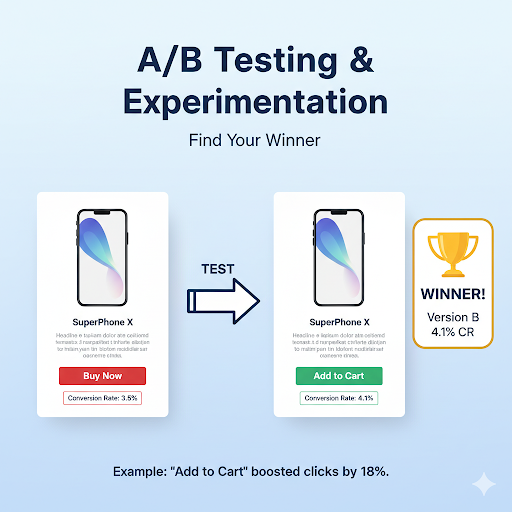
A/B testing and experimentation platforms form the foundation of systematic CRO. These tools let you create variations of page elements (headlines, calls-to-action, product images, checkout flows) and split traffic between them to measure performance differences.
The sophistication varies dramatically between tools. Basic platforms might let you test button colors, while advanced solutions enable testing across dozens of variables simultaneously, running statistical significance calculations in real-time and automatically allocating more traffic to winning variations.
The challenge with A/B testing tools is that they require substantial traffic volumes to reach statistical significance quickly. If your site gets fewer than 10,000 monthly visitors, many experiments will take weeks or months to produce reliable results, which is why some businesses find behavioral analytics more immediately actionable.
Example: Changing a CTA from “Buy Now” to “Add to Cart” can boost clicks by 7–18%.

2. Heatmaps & Session Recording
Heatmap and session recording tools take a qualitative approach to understanding user behavior. Rather than just showing you aggregate metrics like bounce rate, these platforms let you watch recordings of real visitor sessions and see exactly where people click, how far they scroll, and where they encounter friction.
Heatmaps aggregate this behavior into visual representations showing hot and cold zones on your pages. This category of tool excels at surfacing unexpected problems: the broken form field that doesn’t accept input, the mobile menu that requires multiple taps.
The limitation is that these tools diagnose problems but don’t solve them. You’ll identify issues, but you’ll still need either development resources to implement fixes.
Example: A heatmap shows only 20% of visitors scroll past product images → move reviews or CTAs higher.
3. Behavioral Analytics
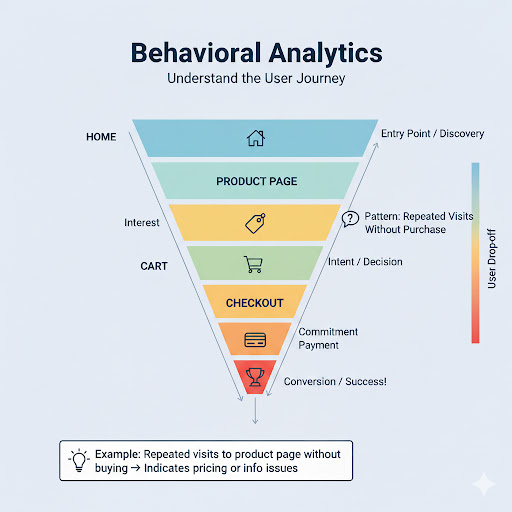
Rather than showing you what happens on individual pages or testing specific variations, these tools analyze patterns across the entire customer journey to reveal underlying intent and identify systematic friction points. Think of it as the difference between watching individual scenes in a movie versus understanding the complete narrative arc.
These platforms track how visitors move through your funnel over time, sometimes across multiple sessions spanning days or weeks. They can identify patterns like customers who repeatedly visit product pages without adding items to cart, users who start checkout three times before completing purchase, or segments that consistently drop off at specific funnel stages. This longitudinal view reveals problems that session-based analytics miss entirely.
The challenge with behavioral analytics tools is that they generate insights without automatically providing solutions. When your analytics platform reveals that users repeatedly visit a product page without buying, it’s flagging a problem but you’ll still need to hypothesize solutions and test them systematically.
Example: Users repeatedly visit a product page without buying → indicates pricing or info issues.

4. Personalization & AI Tools
Personalization tools recognize what mass-market retailers learned decades ago: different customers need different experiences. A first-time visitor browsing from a mobile device in the middle of the workday has different needs than a returning customer on their home computer late at night actively comparing products. Personalization platforms attempt to tailor the experience dynamically based on behavioral signals, demographic data, or explicit preferences.
The newest generation of personalization tools incorporates artificial intelligence and machine learning to make these decisions automatically rather than requiring manual rule creation.
This sounds compelling in theory, but the practical effectiveness depends heavily on data volume. AI-powered personalization requires substantial traffic to train accurate models and avoid overfitting to noise in your data. For sites with fewer than 50,000 monthly visitors, the AI often lacks sufficient data to outperform simple rule-based personalization or even a single optimized static experience.
Example: AI recommendations can increase average order value by 15–30%.

5. Exit-Intent & Retargeting Tools
Exit-intent technology attempts to detect when visitors are about to leave your site and trigger an intervention before they do. The most common implementation uses mouse movement patterns: when your cursor heads toward the browser’s back button or address bar, the tool interprets this as abandonment intent and displays a popup with an offer, discount code, or email capture form.
The effectiveness of these interventions varies dramatically based on implementation. Generic popups with bland messaging like “Wait! Don’t leave!” rarely perform well. The most effective exit-intent campaigns are contextual and specific. If someone is abandoning during checkout, the intervention might address common objections by highlighting free returns, secure payment, or expedited shipping options. If they’re leaving a product page, the popup might offer a limited-time discount or suggest a consultation call.
The fundamental question with exit-intent and cart abandonment tools is whether you’re solving symptoms or causes. If customers are abandoning because your checkout process is confusing, your shipping costs are too high, or your product information is inadequate, these tools provide a band-aid rather than a cure.
Example: Exit-intent popups can reduce cart abandonment by 10–25%.
Evaluating the Leading CRO Platforms: What Actually Matters
After analyzing the current CRO tool landscape and testing platforms with eCommerce clients across various industries, several evaluation criteria emerged as critical for determining real-world effectiveness. These are the factors that determine whether a tool actually improves your conversion rate or just generates reports you’ll never act on.
First, implementation complexity matters more than most buyers realize. A tool with brilliant features that requires three weeks of development work and ongoing IT support often delivers less value than a simpler platform you can activate today.
Second, the quality of insights trumps the quantity of data. Tools that bury you in metrics without clear prioritization create analysis paralysis rather than action.
Third, performance impact cannot be ignored: CRO tools that slow your site speed actually hurt conversions, negating any optimization benefits. Finally, the total cost equation includes not just subscription fees but also the time required to learn the platform, run experiments, and implement findings.
With that framework established, let’s examine how the leading platforms stack up.
Best eCommerce CRO Tools in 2025
1. Everything Green – Carbon CRO (Best CRO Tool for small and medium websites in 2025)
Carbon CRO represents a relatively new approach to conversion optimization that addresses two growing concerns among eCommerce brands: privacy compliance and environmental impact.
Rather than positioning itself as a traditional enterprise CRO platform competing directly with established players, Carbon CRO targets a specific segment of the market: brands that want solid optimization capabilities without the overhead, cost, or performance penalties of older platforms.
The platform’s distinguishing feature is its carbon emissions tracking, which quantifies the environmental cost of different page variations and user journeys. This might sound like a niche concern, but it connects directly to performance optimization.
Pages that load slowly don’t just frustrate users and hurt conversions; they also consume more energy across servers, networks, and user devices. Carbon CRO creates a unified framework where improving sustainability and improving conversions become the same objective rather than competing priorities.
Some of the Key Features include:
- AI-driven analytics
- Eco-friendly technology
- Session recording & behavioral analytics
- Predictive analytics (GA4-enhanced)
- Funnel analysis & user journey mapping
- Personalization & dynamic content
- Exit-intent popups & on-site retargeting
- Cart abandonment reduction tools
Where Carbon CRO currently falls short compared to enterprise platforms is in advanced segmentation capabilities and multivariate testing complexity.
If you need to run experiments with dozens of simultaneous variables or create highly granular audience segments based on complex behavioral sequences in very large traffic websites, you’ll find the platform somewhat limited. The tool is optimized for straightforward A/B tests and behavioral analysis rather than sophisticated statistical modeling. For most small to mid-sized eCommerce businesses, these limitations won’t matter, but enterprise teams with dedicated CRO analysts may find the platform constraining.
When it makes sense: Carbon CRO makes the most sense for eCommerce brands with monthly traffic up to 300,000 visitors who want an all-in-one optimization platform without enterprise complexity or pricing. It’s particularly well-suited for DTC brands, sustainability-focused retailers, and companies operating in privacy-conscious markets
2. VWO (Visual Website Optimizer)
Visual Website Optimizer has been a dominant player in the CRO space for over a decade, and it’s accumulated the feature depth you’d expect from that longevity. The platform offers sophisticated multivariate testing, advanced statistical modeling, detailed segmentation capabilities, and integration with virtually every marketing and analytics tool in existence. Large enterprises with dedicated conversion optimization teams often choose VWO specifically because it can handle complex testing scenarios that would break simpler platforms.
The trade-off for this power is complexity in both implementation and ongoing use. VWO requires technical expertise to implement properly, and the learning curve for marketers is steep. The platform’s script weight has been a consistent criticism: sites often see measurable page speed degradation after VWO implementation, which can hurt the conversions you’re trying to improve.
Pricing reflects its enterprise positioning, starting around $1,499 per month for basic features and scaling rapidly as you add capabilities. For small to mid-sized businesses, VWO often represents an overkill investment: paying for sophistication you don’t need while accepting performance penalties you can’t afford.
When it makes sense: VWO makes sense when you have dedicated CRO specialists, substantial traffic volumes (500,000+ monthly visitors), complex testing requirements, and budget to match. If you’re running dozens of simultaneous experiments across multiple domains with sophisticated targeting rules, VWO’s capabilities justify its cost and complexity. For most businesses, simpler alternatives deliver better ROI.
3. Hotjar: The Behavioral Analytics Gateway
Hotjar occupies an interesting position in the CRO tool ecosystem as the platform that introduces most marketers to behavioral analytics for the first time. Its clean interface and straightforward pricing have made it the default choice for businesses taking their first steps beyond basic Google Analytics, and there’s a reason for this popularity. Hotjar excels at making user behavior visible and understandable, even for people without technical backgrounds or formal analytics training.
The fundamental limitation of Hotjar, however, is that it stops at diagnosis. The platform shows you what’s happening and helps you understand why visitors aren’t converting, but it provides no mechanism for testing solutions or validating that your fixes actually improve performance. This means Hotjar works best as part of a two-tool approach where you use it to identify problems and then use either an A/B testing platform or direct development resources to implement and validate solutions.
The other consideration with Hotjar is its sampling approach. On higher-traffic sites, Hotjar captures a sample of sessions rather than recording everything, which means you might miss important but infrequent edge cases. If you’re trying to diagnose a problem that only affects a specific segment or occurs rarely, you may not capture enough examples to understand what’s happening.
When it makes sense: Hotjar makes the most sense for businesses who want to understand user behavior problems before investing in more sophisticated optimization platforms. It’s valuable for teams that are analytics-adjacent, meaning marketers and product managers who need insights but don’t have dedicated analysts on staff. Once you’ve exhausted the insights Hotjar can provide and you’re ready to test improvements, that’s when you should consider graduating to a platform that combines behavioral with experimentation capabilities
4. Crazy Egg: The Original Heatmap Tool Showing Its Age
Crazy Egg was one of the first heatmap tools to make behavioral analytics accessible to non-technical marketers, and in many ways it defined the category that Hotjar and others later refined. The platform still offers value in specific scenarios, but its age shows in both interface design and feature sophistication compared to more modern alternatives that have learned from its pioneering work.
The platform’s primary appeal is simplicity. Crazy Egg focuses on doing a few things reasonably well rather than attempting to be a comprehensive optimization suite, which can be refreshing after evaluating platforms that bundle dozens of features you’ll never use. The heatmaps are straightforward to set up and interpret, requiring minimal technical knowledge to implement. The confetti heatmaps, which show individual clicks color-coded by traffic source, can surface useful insights about how different visitor segments interact with your pages.
The challenge with Crazy Egg is that it hasn’t evolved significantly while the broader CRO tool landscape has transformed around it. The interface feels dated compared to modern alternatives, lacking the polish and intuitive navigation that users now expect from SaaS platforms. More importantly, the depth of insights available from Crazy Egg’s analytics often feels shallow when you’re trying to diagnose complex user behavior patterns. The session recordings exist but lack the robust filtering and search capabilities that make recorded sessions truly useful at scale. You can watch recordings, but finding the specific sessions that illustrate the problem you’re investigating becomes tedious without sophisticated filtering.
When it makes sense: Crazy Egg makes sense primarily for very small businesses or solopreneurs who want basic heatmap functionality without complexity or expense. However, for any business planning to invest seriously in conversion optimization, starting with a more modern platform saves you from having to migrate your optimization workflow later when Crazy Egg’s limitations become constraining.
FAQs
1. What factors matter most when evaluating CRO platforms?
The three factors that determine real-world success are implementation speed, insight quality, and performance impact.
A tool that takes months to set up properly will delay your optimization program regardless of its features.
Similarly, platforms that generate overwhelming amounts of data without clear prioritization create analysis paralysis rather than action.
Finally, any tool that significantly slows your site speed actively hurts conversions, potentially negating any optimization benefits. Balance these factors against your specific technical resources, traffic volume, and budget constraints.
2. How much traffic do you need to run meaningful CRO experiments?
Statistical significance in A/B testing depends on baseline conversion rates and the size of improvement you’re testing. As a rough guideline, sites with fewer than 10,000 monthly visitors will struggle to reach significance quickly even on high-traffic pages.
Between 10,000 and 100,000 monthly visitors, you can run meaningful tests but should expect multi-week durations.
Above 100,000 monthly visitors, most tests reach significance within days to weeks. If your traffic doesn’t support rapid experimentation, prioritize behavioral analytics tools that provide actionable insights without requiring long-running tests.
3. Should small businesses invest in CRO tools or just fix obvious problems first?
Many businesses jump to sophisticated CRO platforms before addressing fundamental issues like slow page load, broken mobile experiences, or confusing navigation. If your site has obvious usability problems, fix those first using free tools like Google PageSpeed Insights and basic heatmap platforms like Microsoft Clarity. Once you’ve addressed the low-hanging fruit, CRO tools help you systematically optimize the less obvious factors that still impact conversions.
Conclusion: Making Your CRO Tool Decision
The right CRO platform depends entirely on your specific situation. That said, clear patterns emerge based on business size, technical sophistication, and strategic priorities.
For enterprise organizations with dedicated CRO teams and complex testing requirements, VWO remain the standard despite their overhead. The platform handles sophisticated scenarios that newer tools can’t match, justifying their premium pricing for high-traffic properties where even small conversion improvements generate substantial revenue.
Hotjar serves as the CRO entry point, making behavioral insights accessible to marketing teams without requiring analytical expertise or technical implementation complexity. Crazy Egg occupies a similar space but with an older interface and less feature evolution, making it harder to recommend unless you specifically prefer its particular approach to heatmap visualization.
The gap between these tools is where platforms like Carbon CRO position themselves, attempting to provide more analytical depth without the overwhelming complexity and cost of other CRO tools. This middle ground makes sense for many eCommerce businesses because it matches capability to actual organizational needs rather than either under-serving or over-serving the market.
For small to mid-sized eCommerce brands (under $10M annual revenue) looking for an all-in-one solution without enterprise complexity, Carbon CRO offers the best value. The platform bundles behavioral analytics, A/B testing, and AI optimization into a unified interface at pricing that won’t consume your entire marketing budget. The sustainability tracking provides additional value if you’re marketing to environmentally conscious consumers or pursuing B Corp certification.
The CRO tool landscape will continue evolving, but the fundamental principle remains constant: the best tool is the one you’ll actually use consistently to run experiments, gather insights, and systematically improve your conversion funnel.
Features on paper matter far less than your ability to implement, learn, and iterate rapidly.
References
Ricci, F., Rokach, L., & Shapira, B. (Eds.). (2015). Recommender systems handbook (2nd ed.).
Baymard Institute. (2024). Checkout usability: Cart abandonment rate statistics and UX benchmarks.