
When Daniel, the IT director of a mid-sized financial services firm in Singapore, was asked to cut his department’s carbon footprint by 30%, he assumed the answer lay in swapping light bulbs and reducing paper usage. Then his sustainability consultant pointed him toward the server room. His three on-premise data centers, humming quietly in the basement, were responsible for 68% of the firm’s total energy consumption.
Daniel’s situation is far from unique. Across industries and geographies, the infrastructure that powers our digital lives has quietly become one of the world’s most significant energy consumers.
According to Lawrence Berkeley National Laboratory’s landmark 2024 United States Data Center Energy Usage Report, global data center electricity demand reached 415 TWh in 2024, representing approximately 1.5% of worldwide electricity use, with projections indicating this figure will more than double to 945 TWh by 2030.
The International Energy Agency warns that without major innovation in materials and energy efficiency, the rising trajectory of data center energy consumption threatens to undermine global net-zero ambitions.
Yet within this challenge lies one of the most compelling sustainability opportunities of our era. Green data centers, facilities designed from the ground up to minimize energy consumption, maximize renewable energy use, and dramatically reduce carbon emissions, are emerging as the next great frontier of sustainable technology.
For marketers, business leaders, and sustainability professionals alike, understanding this shift is no longer optional. It is a strategic imperative.
This article explores what green data centers are, why they matter, how they work, and what the latest research tells us about their impact. It also connects the hidden environmental cost of digital operations, a theme explored in our previous article on measuring the carbon cost of AI and LLMs, to a broader systems-level solution.
What Is a Green Data Center?
A green data center is a facility specifically designed to minimize its environmental footprint while maintaining full operational reliability. Unlike traditional data centers that prioritize raw performance and uptime without accounting for energy waste, green data centers are architected with sustainability as a first-class design principle.
The defining metrics of green data center performance are:
- Power Usage Effectiveness (PUE): Measures the ratio of total facility energy to IT equipment energy. A PUE of 1.0 represents perfect efficiency. The global average in 2024 stands at 1.56, while leading hyperscale green data centers have achieved PUE ratings as low as 1.06.
- Carbon Usage Effectiveness (CUE): Tracks the carbon dioxide emissions produced per unit of IT equipment energy, linking energy consumption directly to environmental impact.
- Water Usage Effectiveness (WUE): Monitors water consumption per unit of energy used by IT equipment, critical as data centers globally consumed over 600 billion litres of water in 2014 for evaporative cooling alone.
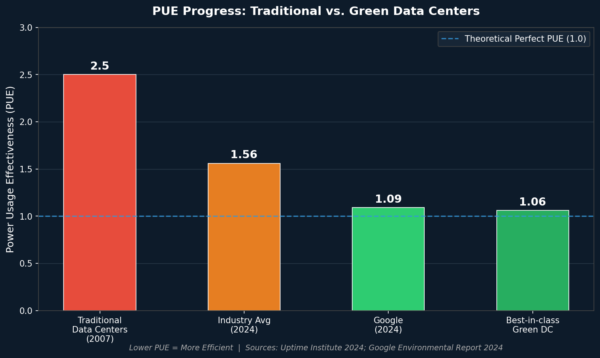
The industry’s overall PUE improvement from an average of 2.5 in 2007 to 1.56 today represents a genuine achievement. However, as Meinhold et al. (2025) note in Sustainable Development, technological efficiency gains in this sector are frequently offset by rebound effects in resource consumption: as each unit becomes more efficient, total demand grows faster than efficiency savings accrue.
This dynamic makes the systemic shift to green data center design, rather than incremental improvements alone, all the more critical.
The Scale of the Problem: Why Data Centers Cannot Be Ignored
At the end of 2024, data centers accounted for approximately 1 to 1.2% of global electricity use and around 0.4% of all greenhouse gas emissions. While these figures may seem modest in isolation, the trajectory is deeply concerning.
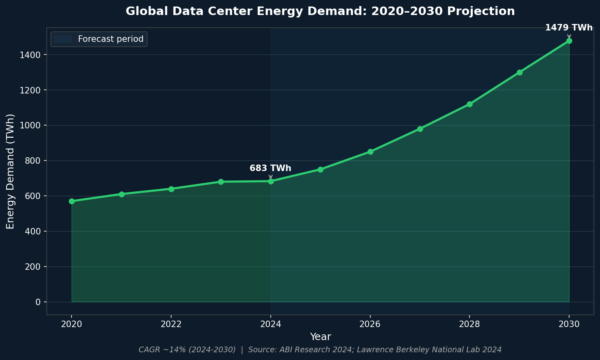
ABI Research projects that data center power consumption will grow from 683 TWh in 2024 to 1,479 TWh by 2030, a compound annual growth rate of 14%. To put that in context, this growth rate is more than four times higher than the overall growth rate of global electricity demand across all other sectors combined.
The primary drivers of this growth are familiar to any digital marketer or technologist: artificial intelligence workloads, cloud computing, blockchain, streaming video, and the proliferation of IoT devices. Each ChatGPT query, each generated image, each AI-optimised marketing campaign contributes to this expanding footprint, a reality explored in depth in our previous research on measuring the carbon cost of AI and LLMs.
For context: a single AI training run for a large language model like GPT-3 consumed approximately 1,287 MWh of electricity, equivalent to the annual energy use of 120 U.S. homes. As AI becomes embedded in everyday marketing workflows, the cumulative footprint of these operations compounds rapidly.
The EU is taking legislative action in response. In 2024, the European Parliament adopted the revised Energy Performance of Buildings Directive, and the Commission is developing a data center energy efficiency labelling package due in 2026. The European Green Deal mandates a 55% reduction in greenhouse gas emissions by 2030 compared to 1990 levels, with data centers explicitly required to achieve climate neutrality by 2030 under the Climate Neutral Data Centre Pact.
The Engineering of Sustainability: How Green Data Centers Work
Green data centers achieve their efficiency gains through a combination of innovations in cooling technology, renewable energy integration, building design, and AI-driven operational management. Understanding each layer is essential for anyone seeking to evaluate or advocate for greener digital infrastructure.
Advanced Cooling Technologies
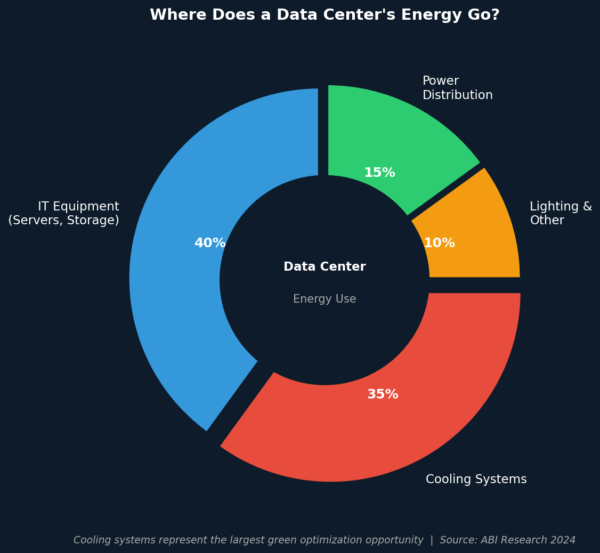
Cooling represents the largest non-computational energy burden in any data center, accounting for 30 to 40% of total facility energy consumption. The transition from traditional air-based cooling to more sophisticated alternatives is therefore the single most impactful lever for reducing a data center’s energy footprint.
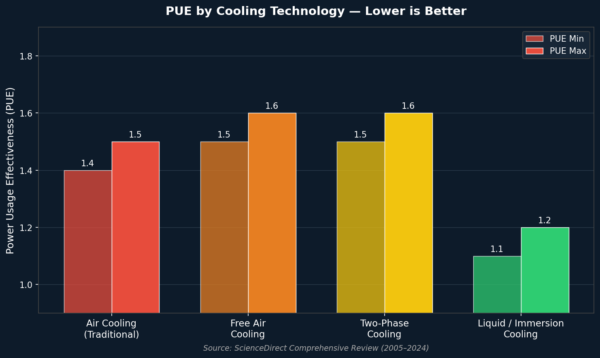
A comprehensive review published in ScienceDirect (2024), covering international research from 2005 to 2024, found the following average PUE performance by cooling technology:
- Air Cooling: PUE of 1.4 to 1.5, energy savings rate of 15 to 20%
- Free Air Cooling: PUE of 1.5 to 1.6, energy savings rate of 25 to 30%
- Two-Phase Cooling: PUE of 1.5 to 1.6, energy savings rate of 35 to 40%
- Liquid / Immersion Cooling: PUE of 1.1 to 1.2, energy savings rate of 45 to 50%
Liquid immersion cooling, in which servers are submerged in a thermally conductive but electrically non-conductive liquid, is particularly promising for AI workloads. Modern AI applications push rack power densities from the traditional 4 to 10 kW per rack to over 100 kW per rack, a thermal load that air cooling simply cannot manage. A 2024 study cited by the U.S. Energy Information Administration found that transitioning from 100% air cooling to 75% liquid cooling reduced overall facility energy use by 15.5%.
Research published in PMC in early 2025 confirms this finding, showing that decreasing PUE from 1.35 to 1.15 through liquid cooling adoption reduced Scope 2 greenhouse gas emissions by 15% and overall facility GHG emissions by 11%.
Geographically advantaged data centers take cooling innovation even further. Iceland’s Verne Global operates without any mechanical chillers by exploiting the island’s cool climate and 100% geothermal and hydroelectric power. Google’s Finland facility uses seawater cooling. These examples show how the physical environment can become a core sustainability asset.
Renewable Energy Integration
Renewable energy sourcing is the second pillar of green data center strategy. The carbon intensity of a data center’s electricity supply varies enormously by geography, from approximately 50 gCO₂/kWh in Iceland to over 700 gCO₂/kWh in coal-dependent regions, making energy source selection a critical sustainability decision.
Industry leaders have made ambitious commitments:
- Google: Achieved a global fleet PUE of 1.09 in 2024, compared to the industry average of 1.56, meaning their data centers use approximately 84% less overhead energy per unit of IT equipment energy. In 2024, Google signed contracts to purchase approximately 8 gigawatts of clean energy capacity, more than in any previous year. The company aims to operate on 24/7 carbon-free energy across all grids by 2030.
- Microsoft: Has committed to being carbon negative by 2030 and is exploring underwater data centers for natural seawater cooling in temperate ocean environments.
- Amazon Web Services: Has committed to 100% renewable energy use and is investing US$700 million in Small Modular Reactor technology for carbon-free baseload power.
For smaller organisations without the leverage to negotiate long-term power purchase agreements, Renewable Energy Certificates (RECs) and participation in community solar or wind projects provide viable pathways to decarbonising data center electricity supply.
AI-Driven Operational Optimisation
Artificial intelligence is being deployed as a tool for reducing the footprint of the infrastructure that runs it. Google reported reducing its data center cooling energy consumption by 30% by deploying AI to optimise its cooling systems in real time. This was achieved by training reinforcement learning models on sensor data across the facility to predict and pre-empt thermal events more efficiently than human operators.
Data Center Infrastructure Management (DCIM) platforms now integrate AI and machine learning for real-time monitoring, predictive maintenance, and workload scheduling. Carbon-aware computing, the automatic routing of workloads to data centers with lower-carbon electricity grids at that moment, is emerging as a powerful extension of this approach. WattTime, for example, provides free API access to real-time grid carbon intensity data, enabling automated scheduling of energy-intensive tasks during periods of high renewable generation.
The Website Carbon Connection: What the Acara Case Study Reveals
A critical insight from our research is that the environmental performance of a data center cannot be evaluated in isolation from the user behaviour it supports. Our Acara Strategy case study, published in December 2025, found that 74% of a website’s total carbon emissions came not from the server infrastructure itself, but from visitors’ devices and the telecommunications network transmitting data to them. The data center’s own operational footprint represented only 9% of total emissions.
This finding has a profound implication: a highly efficient green data center running an unconverted, high-bounce website may actually generate more net emissions than a slightly less efficient data center serving a well-optimised, high-converting site. The relationship between conversion rate and carbon efficiency is direct. On days when Acara’s conversion rate fell, wasted emissions spiked proportionally. Every visitor who arrived, loaded the page, and left without converting represented pure environmental waste.
The often-repeated tension between sustainability and performance is a false dilemma. Optimising for conversions and optimising for the environment are the same objective: helping users accomplish their goals quickly, efficiently, and with minimum wasted energy.
For marketers and digital teams, this means that CRO is not merely a revenue strategy. As our earlier article on Budget CRO demonstrates, the principles of reducing friction, clarifying value propositions, and eliminating unnecessary page weight serve both commercial and environmental ends simultaneously. Faster, cleaner, more purposeful digital experiences consume less energy per valuable interaction.
The Business Case: Beyond Ethics to Competitive Advantage
The transition to green data centers is no longer driven solely by environmental ethics. Research by Chountalas et al. (2025), published in Sustainability, identified critical success factors for green energy integration in data centers, finding that regulatory compliance, investor expectations, and total cost of ownership are increasingly dominant drivers alongside environmental stewardship.
The business case has three clear dimensions.
Cost Reduction. Energy represents 40 to 60% of a data center’s total operating cost. Efficiency improvements directly translate to reduced bills. Google’s fleet-wide PUE of 1.09 versus the industry average of 1.56 translates into enormous operational savings at scale. For SMEs operating on-premise infrastructure, even modest efficiency improvements, such as hot-aisle/cold-aisle containment, server virtualisation, or migrating to renewable-powered cloud services, can generate meaningful cost reductions.
Regulatory Compliance. The European Union’s Corporate Sustainability Reporting Directive (CSRD) requires companies to disclose their entire value chain emissions, including those from digital operations. California’s climate disclosure law extends similar requirements to large businesses operating in the state. As these frameworks expand globally, organisations that have not begun measuring and reducing their data center footprint face increasing compliance costs, legal exposure, and reputational risk.
Market Differentiation. A 2024 study found that 73% of millennials and Gen Z consumers consider sustainability when making purchase decisions. Enterprise buyers increasingly embed sustainability requirements in RFP processes. For marketing agencies, consultancies, and technology service providers, the ability to demonstrate that your digital operations run on green infrastructure is a growing source of competitive advantage. The green data center market itself was estimated at US$73.87 billion in 2024, reflecting the commercial weight now attached to sustainable IT infrastructure.
What Small and Medium Enterprises Can Do Right Now
Green data centers are not exclusively the domain of hyperscalers with billion-dollar infrastructure budgets. SMEs have meaningful pathways to reduce the environmental footprint of their digital operations, regardless of whether they own infrastructure or rely entirely on cloud services.
- Choose cloud providers with strong renewable commitments. Google Cloud, Microsoft Azure, and AWS all offer regions with significantly lower carbon intensity than the global average. Selecting the right region for your workloads is a zero-cost sustainability improvement.
- Implement carbon-aware scheduling. For batch processing, analytics workloads, and content generation tasks, schedule AI-intensive work during low-carbon hours using tools like WattTime’s free API.
- Reduce page weight and improve conversion rates. As the Acara case study demonstrates, the largest share of website carbon emissions comes from visitor devices. Faster, leaner pages that convert better produce fewer wasted emissions per valuable interaction.
- Audit your AI tool stack. As detailed in our guide on measuring the carbon cost of AI and LLMs, using smaller, task-appropriate models for routine work, optimising prompts to reduce regenerations, and batching similar tasks can reduce AI-related emissions by 40 to 70%.
- Ask your providers the right questions. Request transparency from cloud and data center providers about their PUE, renewable energy sourcing, and carbon reporting. Many enterprise contracts now include sustainability clauses. If your provider cannot answer these questions, that is itself useful information.
Frequently Asked Questions
- What is the difference between a green data center and a traditional data center?
A traditional data center prioritises performance and uptime without systematic consideration of energy efficiency or environmental impact. A green data center treats energy efficiency, renewable energy sourcing, water conservation, and carbon reduction as primary design and operational requirements alongside reliability. The practical difference is measurable: leading green data centers operate with PUE scores around 1.09, while the industry average for traditional facilities remains at 1.56.
- Is migrating to a green cloud provider enough to make my business sustainable?
Choosing a renewable-powered cloud provider is an important and relatively easy step, but it addresses only the operational component of your digital footprint. As the Acara case study shows, the majority of a website’s carbon emissions often originate from visitor devices and network transmission, not from the server infrastructure itself. A holistic approach addresses both the supply side (where your compute runs) and the demand side (how efficiently your digital properties use the energy they consume).
- How do I measure my organisation’s data center carbon footprint?
For cloud-based infrastructure, request carbon reporting from your provider. Google Cloud provides the most transparent carbon data, including the ability to select regions by carbon intensity. For on-premise infrastructure, the basic formula is: Carbon Emissions = Energy Consumed × Grid Carbon Intensity. Tools like ML CO2 Impact, Green Algorithms, and Everything Green’s platform can automate this calculation across your stack. Our article on measuring the carbon cost of AI provides a practical step-by-step framework.
- Are green data centers more expensive to build and operate?
Green data centers typically require higher upfront capital expenditure, particularly for renewable energy systems and advanced liquid cooling infrastructure. However, the long-term operational economics are compelling. Energy savings alone can offset the additional capital cost within three to five years at typical energy prices. As Vertiv noted in June 2024, liquid cooling alone can add millions to initial deployment costs, but the total cost of ownership over a 10-year operational period consistently favours green infrastructure.
- What role does AI play in making data centers greener?
AI plays a dual role: it is simultaneously a major driver of increased energy demand and one of the most powerful tools for reducing it. On the demand side, generative AI workloads push rack densities far beyond what traditional cooling can manage. On the supply side, AI-optimised cooling systems have demonstrated 30% reductions in cooling energy consumption. Carbon-aware computing, enabled by machine learning models that predict grid carbon intensity and route workloads accordingly, represents one of the most promising frontiers of sustainable data center operations.
- Will efficiency improvements keep pace with growing demand?
This is the central tension in sustainable data center development. Research by Meinhold et al. (2025) highlights a persistent rebound effect: efficiency gains are regularly outpaced by increased demand and larger model sizes. The PMC study on climate-neutral data centers found that even with significant operational improvements, a Germany-based data center’s overall carbon footprint is projected to increase by 13% between 2020 and 2030 due to rising energy demand. This makes the transition to 100% renewable energy sourcing, not just efficiency improvement, an essential component of any credible sustainability strategy.
- How does website conversion rate relate to data center emissions?
This is one of the most underappreciated connections in sustainable digital strategy. Every visitor who loads your website uses energy, primarily on their own device and through the telecommunications network transmitting data to them. If that visitor fails to accomplish their goal and leaves without converting, all of that energy was wasted. Higher conversion rates mean more valuable outcomes per unit of energy consumed. This is why conversion rate optimisation and sustainability are complementary, not competing, objectives. Our Budget CRO article explores low-cost strategies to improve conversion rates that simultaneously reduce per-conversion carbon emissions.
References
ABI Research. (2024). Data center energy consumption forecast, 2024–2030. ABI Research.
Buyya, R., Ilager, S., & Arroba, P. (2024). Energy-efficiency and sustainability in new generation cloud computing: A vision and directions for integrated management of data centre resources and workloads. Software: Practice and Experience, 54(1), 24–38.
Chountalas, P. T., Chrysikopoulos, S. K., Agoraki, K. K., & Chatzifoti, N. (2025). Modeling critical success factors for green energy integration in data centers. Sustainability, 17(8), 3543.
Coyne, B., Denny, E., & Fitiwi, D. Z. (2023). The benefits of low-carbon energy efficiency technology adoption for data centres. Energy Conversion and Management: X, 20, 100447.
European Commission. (2025, November 17). In focus: Data centres – an energy-hungry challenge. Directorate-General for Energy.
Google. (2025). Operating sustainably: Google data centers, 2024 environmental report. Alphabet Inc.
Lawrence Berkeley National Laboratory. (2024). 2024 United States data center energy usage report. U.S. Department of Energy.
Meinhold, R., Wagner, C., & Dhar, B. K. (2025). Digital sustainability and eco-environmental sustainability: A review of emerging technologies, resource challenges, and policy implications. Sustainable Development, 33(4), 2323–2338.
Onyinyechukwu, C., Peter, E. O., Aniekan, A. U., Bright, N., Adetomilola, V. F., & Kenneth, I. I. (2024). Green data centers: Sustainable practices for energy-efficient IT infrastructure. Journal of Computer Science and Technology Studies, 6(2), 45–58.
Rahaman, A., Noor, K. N., Abir, T. A., Rana, S., & Ali, M. (2025). Green data centres: Sustainable solutions with green energy and green–blue infrastructure. Energies, 18(24), 6592.
Xu, S., Li, Q., & Chen, X. (2024). Towards energy-efficient data centers: A comprehensive review of passive and active cooling strategies. Energy and Built Environment.